


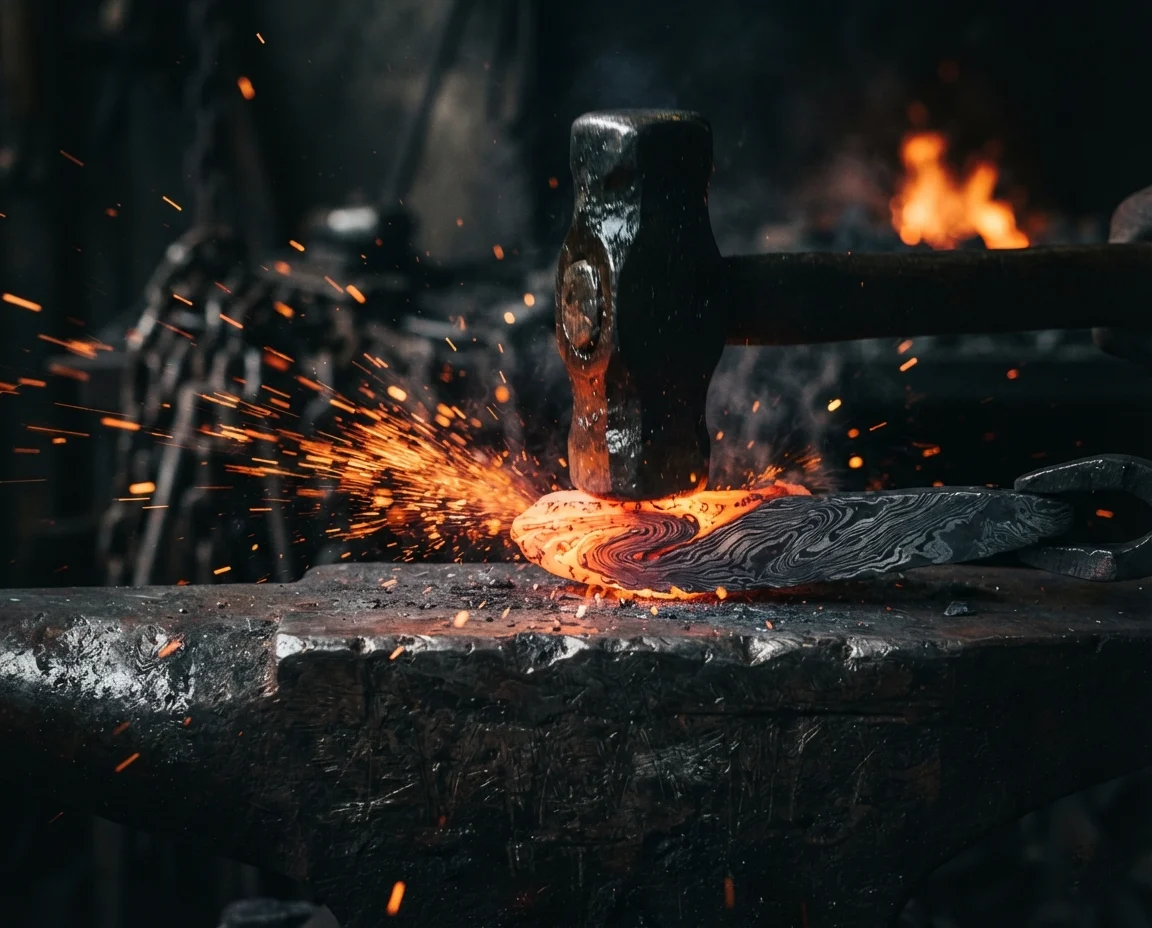
Forging the Future: Inside Our Damascus Process
The swirling, water-like patterns of a Damascus steel blade are instantly recognizable. To the collector, it is a masterpiece of design. To the survivalist, it is an unbreakable tool. But behind every finished blade at Riverside Cutlery lies a grueling, precise journey of fire, iron, and sweat.
True Damascus steel is not painted or etched onto a surface; it is forged into the very DNA of the metal. Here is a look inside our workshop to see how our master blacksmiths combine ancient metallurgical traditions with modern heat-treating techniques to create uniquely patterned, indestructible blades.
Step 1: The Stack and the Fusion
Every custom blade begins as a “billet”—a solid block composed of alternating layers of two distinct steels:
-
- 1095 High-Carbon Steel: Selected for its extreme hardness and ability to hold a razor-sharp edge.
- 15N20 Nickel Alloy Steel: Chosen for its high toughness and bright, silver finish when etched.
Our blacksmiths stack these alternating plates, weld them together at the handle, and place the entire block into a forge roaring at over 2,300°F (1,260°C). Once the steel reaches a glowing, vibrant orange-yellow heat, the atoms begin to migrate. Under the immense pressure of our power hammers, the separate plates fuse into a single, cohesive piece of laminated steel.
[1095 High-Carbon] -> Hardness & Edge Retention
[15N20 Nickel Alloy] -> Toughness & Bright Contrast
      └── Forge Welded at 2,300°F = The Billet Base
Step 2: The Art of the Fold
This is where the magic happens. A single forge weld only yields a few layers. To achieve the legendary density of Damascus, the billet is drawn out, cut in half, stacked again, and re-welded.
By repeating this cycle five to six times, our smiths multiply the layers exponentially—turning 10 layers into 160, 320, or even more.
During this process, the smith introduces specific manipulation techniques. By twisting the white-hot steel, drilling into it, or using specialized dies, they manipulate the hidden layers to create signature patterns like Raindrop, Ladder, or Twist Damascus.
Step 3: Modern Heat-Treating (The Turning Point)
Ancient smiths relied entirely on eyesight and intuition to judge steel temperatures by its color. While we respect that heritage, Riverside Cutlery utilizes modern, digitally controlled kiln ovens to execute the perfect heat-treat. This is where a beautiful piece of metal officially becomes a tool of survival.
-
- Normalizing: The blade is heated and slowly cooled to relieve internal stresses built up from the hammer.
- Quenching: The blade is brought up to its critical temperature (around 1,500°F) and plunged into a specialized oil bath. This rapid cooling freezes the molecular structure into an incredibly hard state called martensite.
- Tempering: In its quenched state, the knife is as brittle as glass. We place it back into a low-temperature oven for several hours. This softens the brittleness just enough to inject immense flexibility and toughness, bringing the blade to an optimal 58-60 HRC on the Rockwell hardness scale.
Step 4: Revealing the Soul
When a knife leaves the grinder, it looks like ordinary, uniform silver steel. The intricate patterns are completely invisible to the naked eye.
To reveal its soul, the polished blade is submerged in a bath of ferric chloride. The acid eats away at the 1095 high-carbon steel layers at a faster rate, turning them a deep, matte grey-black. Meanwhile, the nickel-rich 15N20 layers resist the acid, remaining brilliant and silver.
When the blade is pulled from the acid wash, the contrasting, swirling topography of the Damascus steel is permanently revealed.
Built for a Lifetime
Our Damascus process ensures that the pattern runs completely through the blade. If you were to snap a Riverside Cutlery knife in half, you would see the swirling layers running through its very core. It is this meticulous combination of historical artistry and modern science that ensures your knife isn’t just a display piece—it is an heirloom built to be used, abused, and passed down for generations.
